Volume 75: Carbon in Earth (Open Access) 
Order Publications Online (25% discount for MSA, CMS and GS members, except shipping)
MinPubs.org Pay-Per-View GeoScienceWorld Open Access
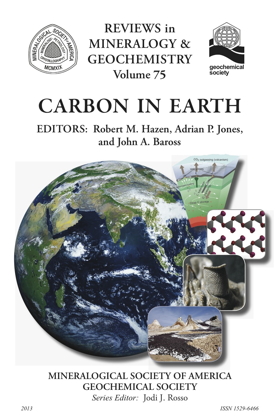
Volume 75: Carbon in Earth
Robert M. Hazen, Adrian P. Jones, and John A. Baross, editors
i-xv + 698 pages. ISBN 978-0-939950-90-4
Carbon in Earth is an outgrowth of the Deep Carbon Observatory (DCO), a 10-year international research effort dedicated to achieving transformational understanding of the chemical and biological roles of carbon in Earth (http://dco.ciw.edu). Hundreds of researchers from 6 continents, including all 51 coauthors of this volume, are now engaged in the DCO effort. This volume serves as a benchmark for our present understanding of Earth's carbon - both what we know and what we have yet to learn. Ultimately, the goal is to produce a second, companion volume to mark the progress of this decadal initiative.
This volume addresses a range of questions that were articulated in May 2008 at the First Deep Carbon Cycle Workshop in Washington, DC. At that meeting 110 scientists from a dozen countries set forth the state of knowledge about Earth's carbon. They also debated the key opportunities and top objectives facing the community. Subsequent deep carbon meetings in Bejing, China (2010), Novosibirsk, Russia (2011), and Washington, DC (2012), as well as more than a dozen smaller workshops, expanded and refined the DCO's decadal goals. The 20 chapters that follow elaborate on those opportunities and objectives.
A striking characteristic of Carbon in Earth is the multidisciplinary scientific approach necessary to encompass this topic. The following chapters address such diverse aspects as the fundamental physics and chemistry of carbon at extreme conditions, the possible character of deep-Earth carbon-bearing minerals, the geodynamics of Earth's large-scale fluid fluxes, tectonic implications of diamond inclusions, geosynthesis of organic molecules and the origins of life, the changing carbon cycle through deep time, and the vast subsurface microbial biosphere (including the hidden deep viriosphere). Accordingly, the collective authorship of Carbon in Earth represents laboratory, field, and theoretical researchers from the full range of physical and biological sciences.
A hallmark of the DCO is the desire to implement advanced strategies in communications, data management, engagement, and visualization. Accordingly, this volume incorporates some novel aspects. Thanks to sponsorship by the Alfred P. Sloan Foundation, which continues to provide significant support for the DCO, this is the first of the RiMG series to be published as an Open Access volume.
Robert M. Hazen, Geophysical Laboratory, Carnegie Institution of Washington
Adrian P. Jones, University College London
John A. Baross, University of Washington
March 2013

Contents of Volume 75
The entire, full-text contents of this volume are free - OPEN ACCESS. The links to the free downloads of the entire book, or individual parts, chapters, supplements, or videos are included with the Table of Contents below. Open Access publication of this volume was sponsored by the Deep Carbon Observatory. The standard print version is also available at Order Publications Online.
The entire volume as a single, compressed pdf file. Download (62.2 MB) 
The volume by individual parts, chapters, supplements, or videos.
- Front Cover Download (995 KB)
- Title Page p. i Download (164 KB)
- Copyright p. ii Download (78 KB)
- Preface p. iii - iv Download (135 KB)
- Table of Contents p. v - vx Download (164 KB)
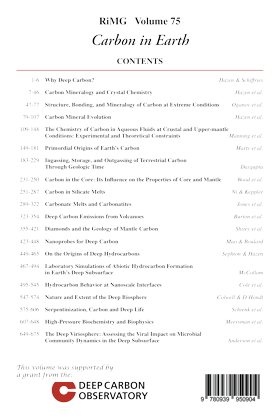
- Chapter 1. Why deep carbon?, by Robert M. Hazen and Craig M. Schiffries, p. 1-6 Download (610 KB)
- Chapter 2. Carbon mineralogy and crystal chemistry, by Robert M. Hazen, Robert T. Downs, Adrian P. Jones, and Linda Kah, p. 7-46
- Download with video (7.5 MB)
- Download with no video (6.6 MB)
- Individual Chapter 2 videos. The user may want to "loop" or "repeat" these video as these clips are quite short:
- Download, Fig 1. graphite Animation, avi version (5.4 MB)
- Download, Fig 1. graphite Animation, mp4 version (5.4 MB)
- Download, Fig 2. diamond Animation, avi version (1.7 MB)
- Download, Fig 2. diamond Animation, mp4 version (2 MB)
- Download, Fig 3. Lonsdaleite Animation, avi version (692 KB)
- Download, Fig 3. Lonsdaleite Animation, mp4 version (700 KB)
- Download, Fig 6. Cohenite Animation, avi version (1.9 MB)
- Download, Fig 6. Cohenite Animation, mp4 version (1.2 MB)
- Download, Fig 8. Calcite Animation, avi version (2.7 MB)
- Download, Fig 8. Calcite Animation, mp4 version (1.5 MB)
- Download, Fig 10. dolomite Animation, avi version (1.4 MB)
- Download, Fig 10. dolomite Animation, mp4 version (2.0 MB)
- Download, Fig 11. Rigid Animation, avi version (2.8 MB)
- Download, Fig 11. Rigid Animation, mp4 version (250 KB)
- Download, Fig 12. Aragonite Animation, avi version (6.4 MB)
- Download, Fig 12. Aragonite Animation, mp4 version (2.0 MB)
- Download, Fig 13. Vaterite Animation, avi version (1.9 MB)
- Download, Fig 13. Vaterite Animation, mp4 version (1.4 MB)
- Download, Fig 14. Huntite Animation, avi version (3.4 MB)
- Download, Fig 14. Huntite Animation, mp4 version (1.7 MB)
- Download, Fig 15. MethaneHydrate Animation, avi version (1.7 MB)
- Download, Fig 15. MethaneHydrat Animation, mp4 version (127 KB)
- Chapter 3. Structure, bonding, and mineralogy of carbon at extreme conditions, by Artem R. Oganov, Russell J. Hemley, Robert M. Hazen, and Adrian P. Jones, p. 47-77
- Chapter 4. Carbon mineral evolution, by Robert M. Hazen, Robert T. Downs, Linda Kah, and Dimitri Sverjensky, p. 79-107
- Chapter 5. The chemistry of carbon in aqueous fluids at crustal and upper-mantle conditions: experimental and theoretical constraints, by Craig E. Manning, Everett L. Shock, and Dimitri A. Sverjensky, p. 109-148
- Chapter 6. Primordial origins of Earth's carbon, by Bernard Marty, Conel M. O'D. Alexander, and Sean N. Raymond, p. 149-181
- Chapter 7. Ingassing, storage, and outgassing of terrestrial carbon through geologic time, by Rajdeep Dasgupta, p. 183-229
- Chapter 8. Carbon in the core: its influence on the properties of core and mantle, by Bernard J. Wood, Jie Li, and Anat Shahar, p. 231-250
- Chapter 9. Carbon in silicate melts, by Huaiwei Ni and Hans Keppler, p. 251-287
- Chapter 10. Carbonate melts and carbonatites, by Adrian P. Jones, Matthew Genge, Laura Carmody, p. 289-322
- Chapter 11. Deep carbon emissions from volcanoes, by Michael R. Burton, Georgina M. Sawyer, and Domenico Granieri, p. 323-354,
- Chapter 12. Diamonds and the geology of mantle carbon, by Steven B. Shirey, Pierre Cartigny, Daniel J. Frost, Shantanu Keshav, Fabrizio Nestola, Paolo Nimis, D. Graham Pearson, Nikolai V. Sobolev, and Michael J. Walter, p. 355-421
- Download (6.1 MB)
- Errata for the print version of Chapter 12's Figure 18 as a pdf (Download (86 KB))
- Chapter 13. Nanoprobes for deep carbon, by Wendy L. Mao and Eglantine Boulard, p. 423-448
- Chapter 14. On the origins of deep hydrocarbons, by Mark A. Sephton and Robert M. Hazen, p. 449-465
- Chapter 15. Laboratory simulations of abiotic hydrocarbon formation in Earth's deep subsurface, by Thomas M. McCollom, p. 467-494
- Chapter 16. Hydrocarbon behavior at nanoscale interfaces, by David R. Cole, Salim Ok, Alberto Striolo, and Anh Phan, p. 495-545
- Chapter 17. Nature and extent of the deep biosphere, by Frederick S. Colwell and Steven D'Hondt, p. 547-574
- Chapter 18. Serpentinization, carbon, and deep life, by Matthew O. Schrenk, William J. Brazelton, and Susan Q. Lang, p. 575-606
- Chapter 19. High-pressure biochemistry and biophysics, by Filip Meersman, Isabelle Daniel, Douglas H. Bartlett, Roland Winter, Rachael Hazael, and Paul F. McMillan, p. 607-648
- Chapter 20. The deep viriosphere: assessing the viral impact on microbial community dynamics in the deep subsurface, by Rika E. Anderson, William J. Brazelton, and John A. Baross, p. 649-675
- Index, p. 677-698
- Back Cover